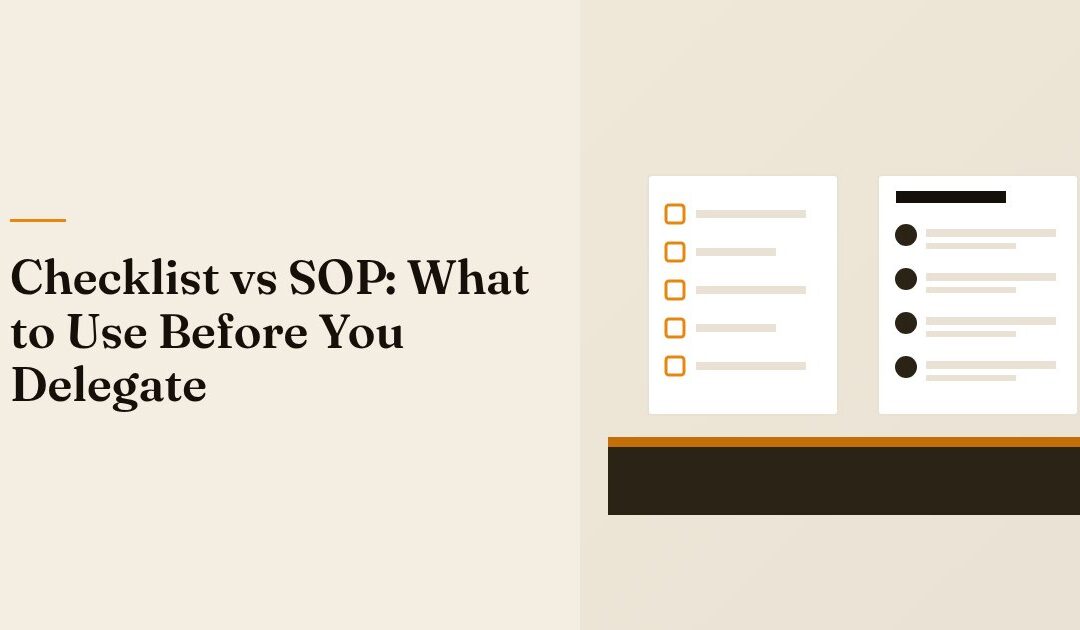
The checklist vs SOP question has a short answer: use a checklist when the person already knows how to do the work and only needs to not forget anything, and use an SOP when they need to know how. One prevents omissions. The other transfers a method.
Most small businesses reach for the wrong one, usually by writing a long procedure for work that needed five tick-boxes, or handing a new hire a bare checklist and wondering why the output is inconsistent.
Checklist vs SOP: The Core Difference
A checklist assumes competence. It lists the things that must be true or done, in no particular depth, and its job is memory. A pilot running pre-flight checks knows how to fly; the list stops a step being skipped under pressure.
An SOP assumes inexperience. It carries the sequence, the judgment calls, the exceptions and the standard for "done". Its job is instruction.
That distinction has a practical consequence. A checklist written for a trained person is useless to someone new, and a full procedure handed to an experienced person gets ignored because reading it is slower than doing the work. Deciding which one you need is not a formatting preference. It is a question about who will be holding the document.
Checklist vs SOP: A Side-by-Side Comparison
| Checklist | SOP | |
|---|---|---|
| Reader | Someone who knows the work | Someone learning the work |
| Job of the document | Prevent omissions | Transfer method |
| Length | Fits on a card, usually 5–15 items | One page, 5–15 numbered steps plus exceptions |
| Contains judgment calls? | No | Yes, including who decides |
| Contains "done looks like"? | Implicitly | Explicitly |
| Used when | Every run, mid-task | During learning, then occasionally |
| Typical failure | Items too vague to tick honestly | Too long, so nobody opens it |
| Good fit | Site visits, month-end close, pre-publish checks | Invoicing, client onboarding, quoting, hiring steps |
Many processes end up needing both: a one-page procedure that teaches the method, and a short checklist pulled out of it that the trained person uses from then on. Write the procedure first. The checklist is a by-product of it, not a separate project.
What to Capture Before You Delegate
The checklist vs SOP decision is downstream of a bigger one: whether you have captured the work at all. Before you hand anything over, get these five things on paper, in this order.
1. The trigger. What event starts the work. Not "Mondays" but "a signed proposal lands in the inbox". If you cannot name the trigger, the task is not ready to delegate, because the person will be waiting for you to tell them to start.
2. The inputs. What the person needs in hand before step one — logins, files, the template they work from, the approval they need. Half of all delegation failures are a missing login.
3. The sequence. The steps in the order they actually happen, one action each. Write them while doing the task, not from memory. Memory smooths out the fiddly parts, and the fiddly parts are what trip people up.
4. The decisions. Every point where you currently use judgment. For each, write the rule you actually apply, and the threshold at which the decision comes back to you. "Discounts up to 10% are yours. Above that, ask me." This is the single highest-value part of any handover document.
5. Done looks like. How the person knows they have finished, in observable terms. Invoice sent and logged in the tracker. Folder created with four named files inside. If you cannot describe the finish line, you cannot delegate the task, only share it.
Then Test It by Handing It Over
A document is a theory until someone else runs it. The test is simple and slightly uncomfortable.
- Give the person the document and the access they need.
- Do not explain it. Explaining it invalidates the test, because you are patching the document out loud.
- Ask them to run the task and write down every point where they had to stop, guess or ask.
- Sit nearby and stay quiet. Let them get stuck. A stuck point is data.
- Afterwards, go through their list and fix the document at each point. Not in conversation — in the document.
- Run it once more with a different person if you have one.
The questions they ask are a map of what is missing. Count them. On the second run, there should be noticeably fewer, and the ones left over are usually genuine judgment calls that belong in the decisions section with a threshold attached.
Two rounds of this usually gets a procedure to the point where it works without you. One round rarely does.
When Neither One Is the Right Answer
Some work should not be documented yet.
The task is still changing week to week. Documenting an unstable process locks in a method you are about to abandon. Wait until the shape has held for a month or two.
You have done it twice. You do not yet know what the exceptions are. Write rough notes, keep doing it, document it properly on the fifth or sixth run.
It is a one-off. A project with no repeat has no procedure to write. Write the handover notes and move on.
The real problem is a decision you have not made. If three people do the task three ways because you have not decided which way is right, no document will fix that. Decide first, then write it down.
Which Order to Build Them In
If you are starting from nothing, build in this sequence rather than trying to cover everything at once.
- The interruption list. For one week, note every question someone asks you that you have answered before. That list is your documentation backlog, ranked by cost, without any guessing.
- A one-page procedure for the top item. Full method, including exceptions and decision thresholds.
- A checklist pulled out of it for whoever will run it repeatedly once trained.
- The handover test, twice.
- The next item on the interruption list.
That loop is slow and it works. The alternative — a documentation sprint where you try to write forty procedures in a weekend — produces a folder of documents nobody has tested, which is indistinguishable from having nothing.
Pick One Task This Week
Look at the work that only you can currently do, and find the piece of it that gets asked about most. Write the procedure for that one, pull a checklist out of it, and hand it to someone with your mouth shut. You will learn more about your own operation in that hour than in a month of planning.
The SOP templates page has the one-page procedure format with the exception and decision blocks already built, and the matching checklist layout alongside it, so you can produce both from a single pass at the task. The broader template library covers the documents that usually come next — onboarding packs, process trackers, role handover sheets — and the free business growth template download page is a sensible place to try the format on one task first.
One caution on the decisions section: where a threshold touches employment status, contractor terms, pay or tax treatment, the rules differ by jurisdiction, and a lawyer or accountant where you operate should review the wording. Templates are a starting point for structure, not professional advice.